What to wear on Ben Nevis
Want someone to lead the way?Most people walk Ben Nevis on their own, and on a clear summer day the Mountain Track is easy to follow. If you would rather have a local guide set the pace, read the weather and find the way off the summit plateau, these are the guided hikes you can book.
Compare the optionsCan you climb Ben Nevis in trainers?
Walking boots are best; proper trail or hiking shoes with a grippy sole are acceptable in dry summer conditions; gym trainers and fashion shoes never. Mountaineering Scotland says “Hiking boots with a Vibram sole are strongly recommended”, accepts good quality hiking trainers, and rules out flip-flops, wellies, normal shoes and gym trainers. The Visitor Centre asks for sturdy boots and warns that the path is rocky and “can be dangerously slippery, especially when wet”.
The Mountain Track (also called the Pony Track or Tourist Path) is well made, but it is made of stone, and the zig-zags near the top are loose. For years I have watched people set off in gym trainers and a cotton hoodie because it was sunny in Fort William, and meet them again by the lochan on the way down, soaked and sliding on every step. Grip matters more going down than going up.
The summit is another climate
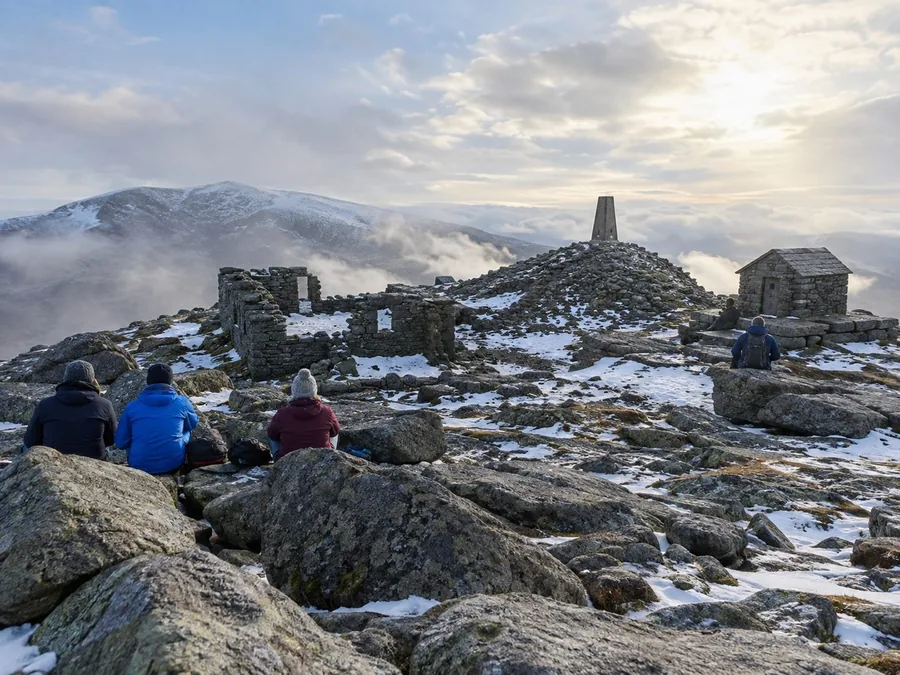
The Visitor Centre puts the summit at around 8.5 °C colder than the base. The old observatory records give the summit a mean annual temperature of −0.5 °C, over 4,300 mm of rain a year and 261 gales in an average year, with snow on the mountain around seven months of the year. Mountaineering Scotland’s warning is plain: “Even in summer, the summit and higher slopes” can be very cold, wet, windy and covered in snow.
So dress in layers you can add and take off. The same page lists what it treats as essential: “Warm, wind and waterproof clothing is essential including gloves, hat, fully waterproof and windproof jacket and trousers.” It also says cotton clothing such as jeans and T-shirts is not recommended. Cotton holds sweat and rain and stays cold for the rest of the day.
Kit by season
| Item | Summer | Spring and autumn | Snow on the mountain |
|---|---|---|---|
| Footwear | Walking boots, or grippy hiking shoes when dry | Walking boots | Rigid mountaineering boots that take crampons |
| Waterproofs | Jacket and trousers | Jacket and trousers | Jacket and trousers |
| Warm layers | A fleece or light insulated jacket | Fleece plus insulated jacket | Several, plus a spare |
| Hat and gloves | Yes, and a sun hat | Warm hat and gloves | Warm hat, gloves and a spare pair |
| Head torch | Yes | Yes | Yes, with spare batteries |
| Extra | Sun cream, midge repellent | — | Ice axe, crampons and the skills to use them |
Walking poles
No source says you must have them, and you can manage without. I carry mine for the descent: on the zig-zags they take some of the load off your knees and give you two extra points of contact on the loose stone. Fold them away anywhere you want your hands, and on the Carn Mor Dearg (CMD) Arête that means most of the ridge.
Water and food
Mountaineering Scotland recommends a minimum of two litres of fluid per person, and the Visitor Centre says at least 2 litres per person on a sunny day. There is no drinking water on the summit, and the stream water on the way up is not tested, so carry it all from the start, and more on a warm day. For food, the suggestion is “chocolate, dried fruits, cheese and biscuits”, and I add a proper lunch. Eat something at the lochan, again at the top of the zig-zags, and again on the summit. There are no bins anywhere on the mountain, so every wrapper comes back down with you. What to do about toilets is on toilets on Ben Nevis.
Map, compass, phone and head torch
- Map and compass, and the skill to use them. The Visitor Centre’s answer to “do I need them?” begins “Yes you do”, because visibility on the plateau “can quickly drop to a couple of metres”. Carry the summit bearings too: from the trig point, walk 150 m on a grid bearing of 231°, then follow a grid bearing of 282° (Mountaineering Scotland). They are grid bearings, so allow for magnetic variation, and they go with the map and compass, never instead of them.
- A head torch, in every month.
- A charged phone. Signal is patchy on parts of the mountain. Register for emergency SMS before you go by texting “register” to 999 and following the reply.
- A whistle: six blasts, repeated every minute, is the call for help.
- A first aid kit and an emergency shelter or bivvy bag.
Pack a spare pair of gloves as well. One reviewer of the guided hike wrote that the guide “brought a spare pair of gloves as I lost mine”, and on the summit in wind that is not a small thing. Why the bearings matter, and what lies either side of the way off, is on the summit page; the full call-out procedure is in Mountaineering Scotland’s guide to calling for help.
Winter kit and the skills
Snow can cover the upper mountain into early summer, and then, in Mountaineering Scotland’s words, you may need “an ice axe, rigid mountaineering boots and crampons”. VisitScotland says winter climbing is only for experienced mountaineers with specialist skills and kit. Kit without the skills to use it does not make a winter day safe; if you have neither, walk lower down or go with a qualified leader. When the snow usually lies is on the best time to climb Ben Nevis.
Going with a guide
A guide does not carry your kit for you. The guided group hike on GetYourGuide excludes equipment, lunch and drinks, and its listing warns that winter equipment may be required for hikes at the start of May. The Mountain Leader version excludes personal hiking gear. Either way, the list above is yours to bring. The group hike rates 4.6 from 14 reviews and runs about 8 hours from the Ben Nevis Visitor Centre; check dates in the booking box.
Frequently asked questions
Can you climb Ben Nevis in trainers?
Walking boots are best. Proper hiking shoes with a grippy sole are acceptable in dry summer conditions, but never gym trainers or fashion shoes: the path is rocky and slippery when wet.
What should I wear to climb Ben Nevis?
Walking boots, a waterproof jacket and trousers, warm layers, a hat and gloves, whatever the weather in town. The summit is around 8.5 °C colder than the base before wind. Avoid cotton.
How much water do I need for Ben Nevis?
At least 2 litres per person, and more on a warm day. There is no drinking water on the summit and the streams are not tested.
Do I need a map and compass on Ben Nevis?
Yes, and the skill to use them. Cloud on the plateau can cut visibility to a couple of metres. What keeps people safe is on is Ben Nevis safe.
Do you need crampons for Ben Nevis?
When snow covers the upper mountain, yes: an ice axe, crampons and rigid boots, and the skills to use them. Snow can lie into early summer.