Ben Nevis, explained by a local
Ben Nevis is the highest mountain in the United Kingdom, 1,345 m (4,413 ft), rising out of Glen Nevis above Fort William in Lochaber. I grew up in Fort William with the Ben in the kitchen window, and this is what I tell visitors who ask me how to get up it and down again.
Want someone to lead the way?Most people walk Ben Nevis on their own, and on a clear summer day the Mountain Track is easy to follow. If you would rather have a local guide set the pace, read the weather and find the way off the summit plateau, these are the guided hikes you can book.
Compare the optionsThe mountain and its name
In Gaelic it is Beinn Nibheis, the mountain of the Nevis, after the river and the glen. Nobody knows for certain what Nibheis means. One old theory links it to a Gaelic word for venomous or malicious; another links it to clouds and water, “the misty one”. The Ordnance Survey re-measured the summit by GPS in 2016 and it went from 1,344 m to 1,345 m: the mountain did not grow, the measuring got better. The John Muir Trust owns the summit.
Anyone can walk up
There is no ticket and no booking needed to walk up. The mountain is open to everyone, any day of the year, and well over 100,000 people a year go to the top; the John Muir Trust now puts it at more than 160,000. The Mountain Track (also called the Pony Track or Tourist Path) was built in 1883 to supply the summit Observatory, and it is a made path all the way to the plateau. For people who prepare, it is a safe mountain. It is also a long one, and the top third is a rough slog up zig-zags of loose stone.
Two ways up, and which to take first
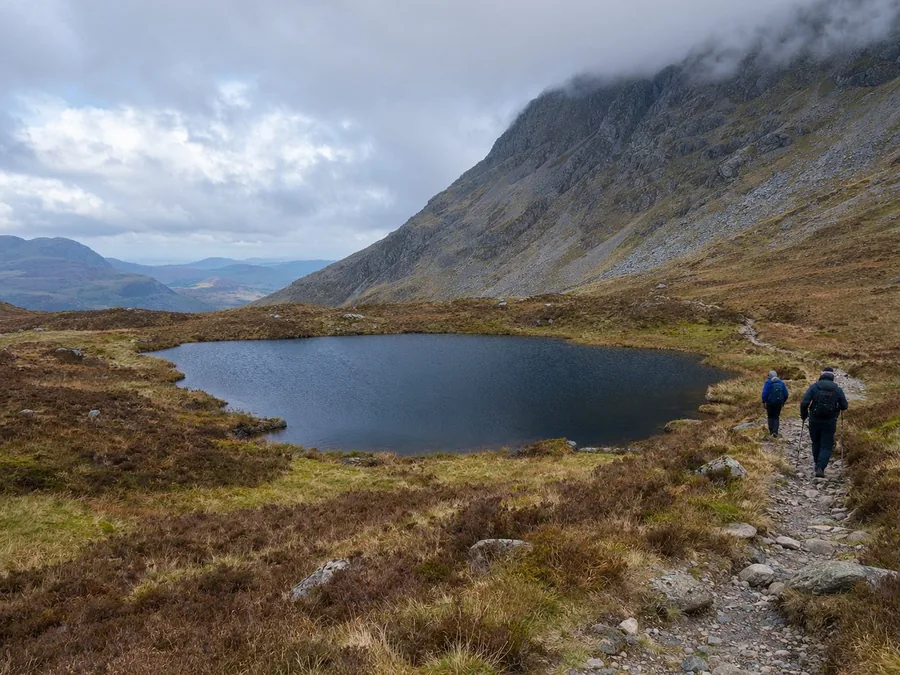
The Mountain Track has three starts: the Visitor Centre, Achintee and the Glen Nevis Youth Hostel. They meet on the lower slopes of Meall an t-Suidhe, and the path climbs past the Halfway Lochan to the zig-zags and the plateau. The other walkers’ route is the Carn Mor Dearg (CMD) Arête: from the North Face car park at Torlundy up the Allt a’ Mhuilinn, over Carn Mor Dearg and along a narrow rocky ridge to the summit. It is an exposed Grade 1 scramble, about 16–19 km with 1,500 m or more of climbing, and VisitScotland allows 10 to 11 hours. It is for experienced hillwalkers in dry, calm, clear weather. For a first ascent I send everyone up the Mountain Track. See the routes compared and the CMD Arête explained.
Time, distance and the start-time rule
Allow 7 to 9 hours there and back on the Mountain Track: about 16–17 km (10–10.5 miles) and 1,300–1,350 m of climbing, almost the full height of the mountain from near sea level. VisitScotland puts 3.5 to 4.5 hours on the way up. My rule is to count backwards from dark: the hours the walk takes, plus a margin for breaks and tired knees on the way down. In summer that means walking by 08:00, when the Visitor Centre opens. I have watched people set off at 13:00 in October; the arithmetic does not work. Pick a turnaround time and keep to it.How long it takes works it through.
Weather, and the plateau in cloud
The summit is in cloud more often than not, roughly 70% of the time, and least often in early summer. High Life Highland reckons it is around 8.5°C colder than the base before you add the wind. I read two forecasts the evening before and again at breakfast: the MWIS West Highlands forecast and the Met Office mountain forecast.
The one thing that catches people out on Ben Nevis and not on Snowdon is the summit plateau in cloud. The top sits on the edge of the north-face cliffs, with steep gullies on either side of the way down, and walkers heading off in cloud tend to drift towards Five Finger Gully. Take a map and compass and know how to use them. The bearings Mountaineering Scotland publishes are these: from the trig point, walk 150 m on a grid bearing of 231°, then follow a grid bearing of 282°. They are grid bearings, so allow for magnetic variation on your compass. Following other people’s footprints is not a plan.
Snow into early summer
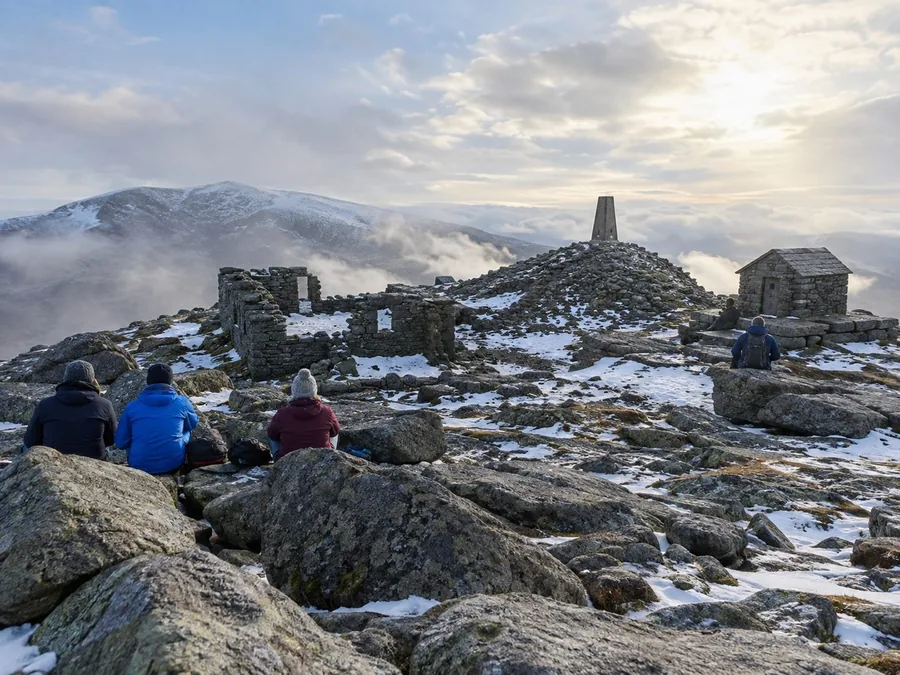
Snow lies on the mountain for around seven months of the year, and it can cover the upper part into early summer. Then, Mountaineering Scotland says, you may need an ice axe, rigid mountaineering boots and crampons, and you need the skills to use them. From roughly mid-December to early April, read the SAIS Lochaber avalanche forecast as well. June to September gives the best chance of a path clear of snow and long days. The best time to climb goes month by month.
What the tours sold here add
I earn nothing when you walk up on your own, and most people do. GetYourGuide sells three guided hikes up the Ben: a group hike from the Visitor Centre, about 8 hours, 4.6 from 14 reviews; the same route with a qualified Mountain Leader, which costs more and has no reviews yet; and a pick-up from Glasgow Queen Street, about 14 hours with five in a car, one review so far. A guide sets the pace, reads the weather and finds the way off the plateau. To see the Ben without climbing it there is an evening cruise from Fort William Town Pier and two coach days from Glasgow. All six compared sets them out.
What I’d tell a friend
Three things. Start early: be walking by 08:00 in summer, and arrive before the small Visitor Centre car park fills. Carry a map and compass with the two bearings written on a card in your pocket, and practise with them before the day, not on the plateau. And set your turnaround time in the car park, not on the mountain; turning back at the Halfway Lochan is still a good day out. Trains, buses and parking has the rest.
Ready to go?
Most people walk up on their own, and the routes compared page is where I would start. If you would rather go with a guide who sets the pace and finds the way off the summit plateau, the group hike below walks the Mountain Track from the Visitor Centre; or compare every guided option. The live price and dates are in the booking box.
Frequently asked questions
Which route up Ben Nevis is best for a first time?
The Mountain Track from the Visitor Centre: a made path all the way, with no scrambling. The routes compared.
How long does it take to walk up Ben Nevis?
Allow 7 to 9 hours up and down, including stops. Times and start times.
What should I wear to climb Ben Nevis?
Walking boots, warm layers, full waterproofs, a hat and gloves, whatever the weather in Fort William. The full kit list.