Ben Nevis facts and names
Want someone to lead the way?Most people walk Ben Nevis on their own, and on a clear summer day the Mountain Track is easy to follow. If you would rather have a local guide set the pace, read the weather and find the way off the summit plateau, these are the guided hikes you can book.
Compare the optionsHow high, and the 2016 resurvey
For years the official height was 1,344 m, the figure from 1949. In 2016 the Ordnance Survey measured it again with GPS and got 1,344.527 m, which rounds to 1,345 m (4,413 ft). The mountain did not grow; the measuring got better. So if you see 1,344 m in an older book, that is why. The Ordnance Survey confirmed it as the highest peak in Britain and Ireland back in 1847.
The highest point in Scotland
The highest point in Scotland, and in the whole of the UK, is the summit of Ben Nevis: the trig point on top of the big cairn, at grid reference NN 166 712, above Fort William and Glen Nevis. The summit plateau around it is about 40 hectares of stones, with cliffs on three sides. What else is up there is on the summit page. Locals call it the Ben.
Why “the venomous mountain”
Beinn Nibheis means “the mountain of the Nevis”, named after the river and the glen. The argument is over what Nibheis itself means. The Visitor Centre says it translates as “malicious” or “venomous”, and also gives “the mountain with its head in the clouds”. The scholar W. J. Watson traced the river name to an Old Gaelic word for “venomous one”; W. F. H. Nicolaisen preferred a much older root connected with water and clouds, “the moist one” or “the misty one”. Nobody knows for certain. Having spent more summit visits in cloud than out of it, I lean towards the misty one.
What Scots call hills
Scots use hill for almost anything; the big ones are bens, from the Gaelic beinn. Hillwalkers then sort them by height:
- Munro: a Scottish mountain over 3,000 ft (914.4 m) on the Scottish Mountaineering Club’s list, first drawn up by Sir Hugh Munro in 1891. There are 282. Ben Nevis and Carn Mor Dearg are both Munros, and people who climb all of them are Munroists.
- Corbett: 2,500–3,000 ft, with at least 500 ft of drop all round. There are 222.
- Graham: 2,000–2,500 ft, with 150 m of prominence. There are 219.
The Gaelic words on the map tell you what shape to expect. Beinn is a mountain, sgùrr a pointed, craggy peak, meall a rounded hill (Meall an t-Suidhe, above the Halfway Lochan), càrn a hill or pile of stones, stob a point on a ridge, bealach a pass, coire a corrie, allt a stream and lochan a small loch. In Scots rather than Gaelic, a law is a hill, a knowe a rounded one and a brae a hillside.
A short history
- 1771: the first recorded ascent, by the Edinburgh botanist James Robertson, on 17 August.
- 1818: the poet John Keats climbs it.
- 1881: Clement Wragge makes daily weather observations on the summit all summer, which earned him the nickname “Inclement Rag”.
- 1883: the Mountain Track (also called the Pony Track or Tourist Path) is built as a bridle path to supply a summit observatory, which opens on 17 October. Its first winter brings about 4 m of snow.
- 1904: the observatory closes for lack of funding. Its ruins are still on the summit, and its hourly records have since been digitised by volunteers.
- 2000: the John Muir Trust buys the Ben Nevis Estate, 1,761 hectares including the summit and the south side of the mountain. It maintains the upper stretch of the path.
A collapsed volcano
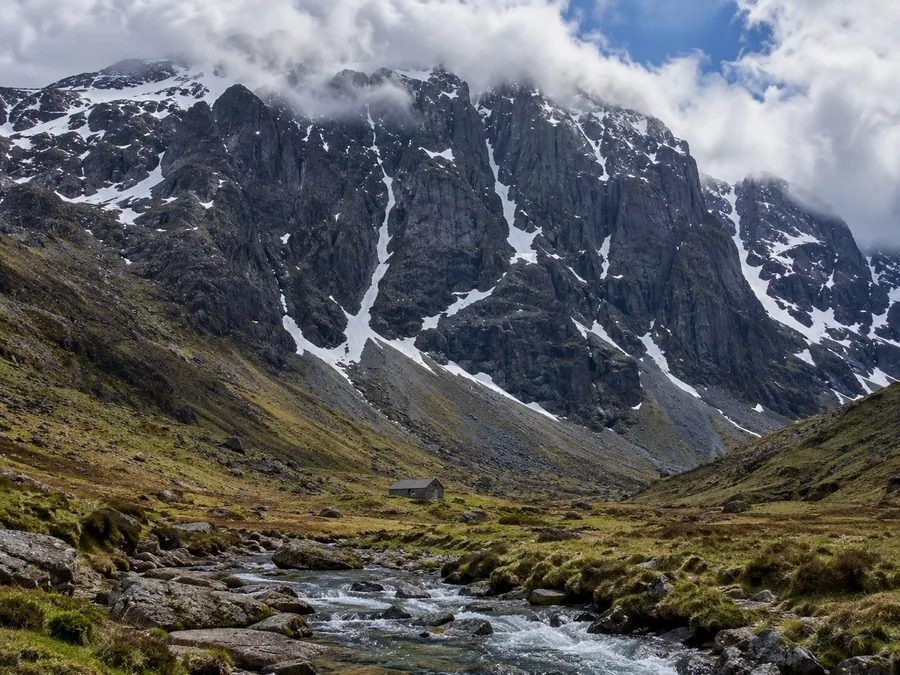
Ben Nevis is what is left of a volcano active about 400 million years ago. Its centre collapsed along a ring of faults, dropping hundreds of metres; the Lochaber Geopark says the rocks now seen on the north face fell about 600 m. The north face cliffs are around 600–700 m high, and the mountain is protected for its geology.
The Ben Nevis Race
Every year on the first Saturday in September, up to about 600 runners leave Claggan Park in Fort William, run to the summit and back, about 14–16 km with 1,340 m of climbing. The men’s record is 1:25:34, set by Kenny Stuart in 1984. The women’s is 1:43:01, set by Victoria Wilkinson in 2018. Walkers should plan on 7 to 9 hours for the same route; how that breaks down is on how long it takes.
The piano and the car
In 1911 a Ford dealer, Henry Alexander, drove a Model T to the summit as a publicity stunt. It took five days to get up and one to get down. In 2006 the John Muir Trust found a piano buried under one of the summit cairns, believed to have been carried up for charity more than 20 years before. There is still no road, railway or lift up Ben Nevis. The gondola near Fort William goes up Aonach Mòr, a different mountain.
Weather at the top
The observatory records give a summit with an average yearly temperature just below zero, about 4,350 mm of rain a year and 261 gales in an average year. The Visitor Centre puts the summit around 8.5 °C colder than the base, with snow for around seven months of the year and patches that last all summer on the north face. How Ben Nevis compares with the other two of the Three Peaks is on Ben Nevis or Snowdon.
The oldest person to climb it
Nobody keeps an official record of ages on Ben Nevis, and the claims in the papers cannot be checked, so I do not name one. What I can say is that there is no age limit and older walkers go up every summer. What matters is stamina for 7 to 9 hours on rough stone, not the number on your birthday card.
Walking it with a guide
The flagship guided booking is the group hike from the Ben Nevis Visitor Centre, up the Pony Track, about 8 hours, in the summer season (check dates in the booking box). It rates 4.6 from 14 reviews. Eszter, from Germany, reached the top in wind and cloud, and wrote that “the clouds cleared for about three seconds”, just long enough for her guide to point out the view. That is the Ben. The reservation comes from David John, who gave it one star: the guide set a pace so fast that he turned back with cramp. Tell the guide at the start if you walk slowly. Lunch, drinks and equipment are not included. Full refund if you cancel up to 24 hours ahead.
Frequently asked questions
What is the highest point in Scotland?
The summit of Ben Nevis, 1,345 m (4,413 ft), above Fort William. It is also the highest point in the UK and the British Isles.
Why is Ben Nevis called the venomous mountain?
Because one old theory links Nibheis, in the Gaelic name Beinn Nibheis, to a word for “venomous” or “malicious”. Another links it to clouds and water, “the misty one”. Nobody knows for certain.
What do Scots call hills?
Mostly just hills; the big ones are bens, from the Gaelic beinn. Hillwalkers sort them into Munros (over 3,000 ft), Corbetts (2,500–3,000 ft) and Grahams (2,000–2,500 ft).
Who is the oldest person to climb Ben Nevis?
There is no official record, and the claims reported in the press cannot be checked, so I do not name one. There is no age limit; what counts is stamina for a 7 to 9 hour day. More on Ben Nevis for beginners.
Who owns Ben Nevis?
The John Muir Trust has owned the Ben Nevis Estate, including the summit and the south side of the mountain, since 2000.
Can you drive or take a train up Ben Nevis?
No. There is no road, railway or lift. The only ways up are on foot, and the usual one is the Mountain Track from Glen Nevis; the others are on the routes compared.